It is THAT time of year again … when property owners around our province are finding envelopes from BC Assessment in their mailboxes and learning if the assessed values of their homes and land have changed significantly during last year’s cycle. Most property owners are concerned that their property taxes will increase along with an increase in assessed property value, but this is not automatically the case. We also share a concern when property values drop signifcantly. I recently attended Victoria Real Estate Board’s 2026 BC Assessment webinar and would like to share what I learned.
Our BC Assessments are determined July 1st of the previous year, and depend on the physical condition and permitted use of the property as of October 31st. A provincial mass appraisal system considers present use, both orginal cost and replacement cost, property location, a comparison of selling price of land and improvements with similar properties, revenue/rental value, and both functional and economic obsolescence of the current property. Such physical factors like size, age, condition and quality of any buildings and improvements, the shape and topography of the land, and the availability of services are also factored in.
The basis for current market value is determined by the highest and best use of a property. Assessors must determine the answers to the following four questions: What is physically possible at this site considering location, geotechnical and slope variablities etc? What is legally permissable with respect to zoning bylaws, community plans, and restrictive covenants? What is financially feasible? What is the maximally productive use for the property? Depending on the class of property being assessed, one of three approaches to appraising its value will be used. For example, a direct comparison approach is used to appraise value for Single Family Dwellings based upon what similar properties have been recently selling for. An income approach to assessment is used to appraise commercial/industrial properties that generate income. Thirdly, a cost approach is used to assess those property types that don’t typically trade, such as airports and mills.
There are 9 property classes legislated in BC and assessed every year. Our property tax rates are set by bylaw each spring by our municipal taxing authorities and submitted to the Ministry of Housing and Municipal Affairs for review. The property tax that is payable by property owners every July 1st is the assessed value of the property multiplied by its property tax rate. If your property’s value increases more than average compared to other properties in its property class, then likely your property taxes will also increase. If your property’s value change is lower than the average change for its property class, then your taxes are likely to decrease. If your property’s assessed value change is similar to the average change for its property class, then likely your taxes will not significantly change.
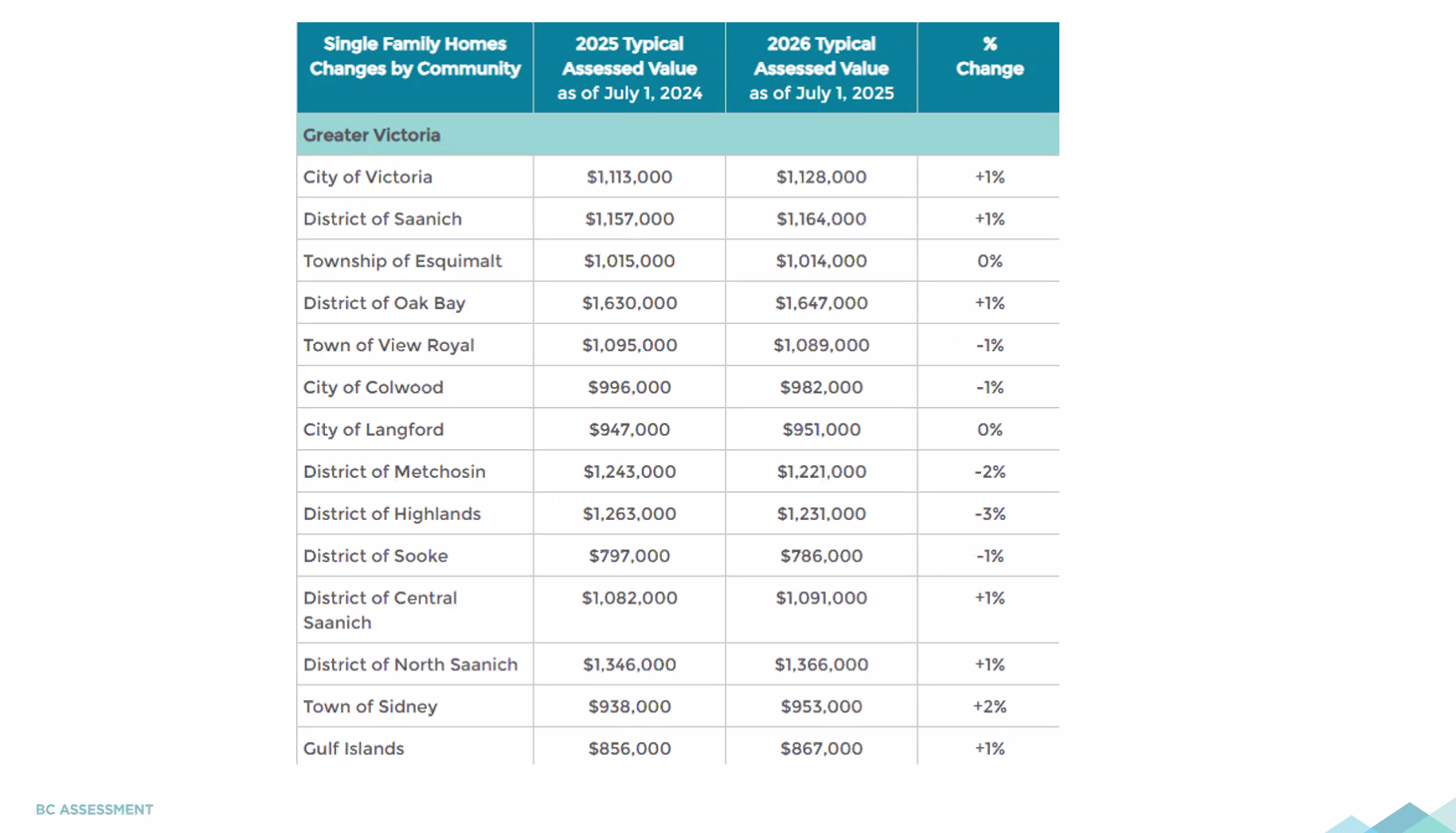
In 2025, the total property value of the assessment roll decreased 2.5% in British Columbia. The good news is that on Vancouver Island the total value of all property values assessed increased 1%. Assessment does change by community and on Vancouver Island both Single Family Dwellings and Strata Properties held pretty stable, between -5% to +5%. In Greater Victoria, Single Family Dwellings trended downwards a slight 1.2% on average. Currently, according to BC Assessment, the hot spots on Vancouver Island that saw the greatest increases in assessed property values are Uclelet (+5%), Zeballos (+5%), and Alert Bay (+7%).
This interesting chart highlights the changes in the assessment values of single family homes by community in Greater Victoria.
Contact BC Assessment at 1-866-825-8322 to speak with someone about your property assessment concerns. You can also call your local BC Assessment Office by using the phone number printed on your Property Assessment Notice. Your assessment will be corrected if the appraiser is in agreement with you that an error was made. If your concerns are not satisfied then the next step is for you to file a written Notice of Complaint with your local BC Assessment Office to seek an independent review. This year, because January 31 falls on a weekend, the last date to submit your written request is February 2, 2026.